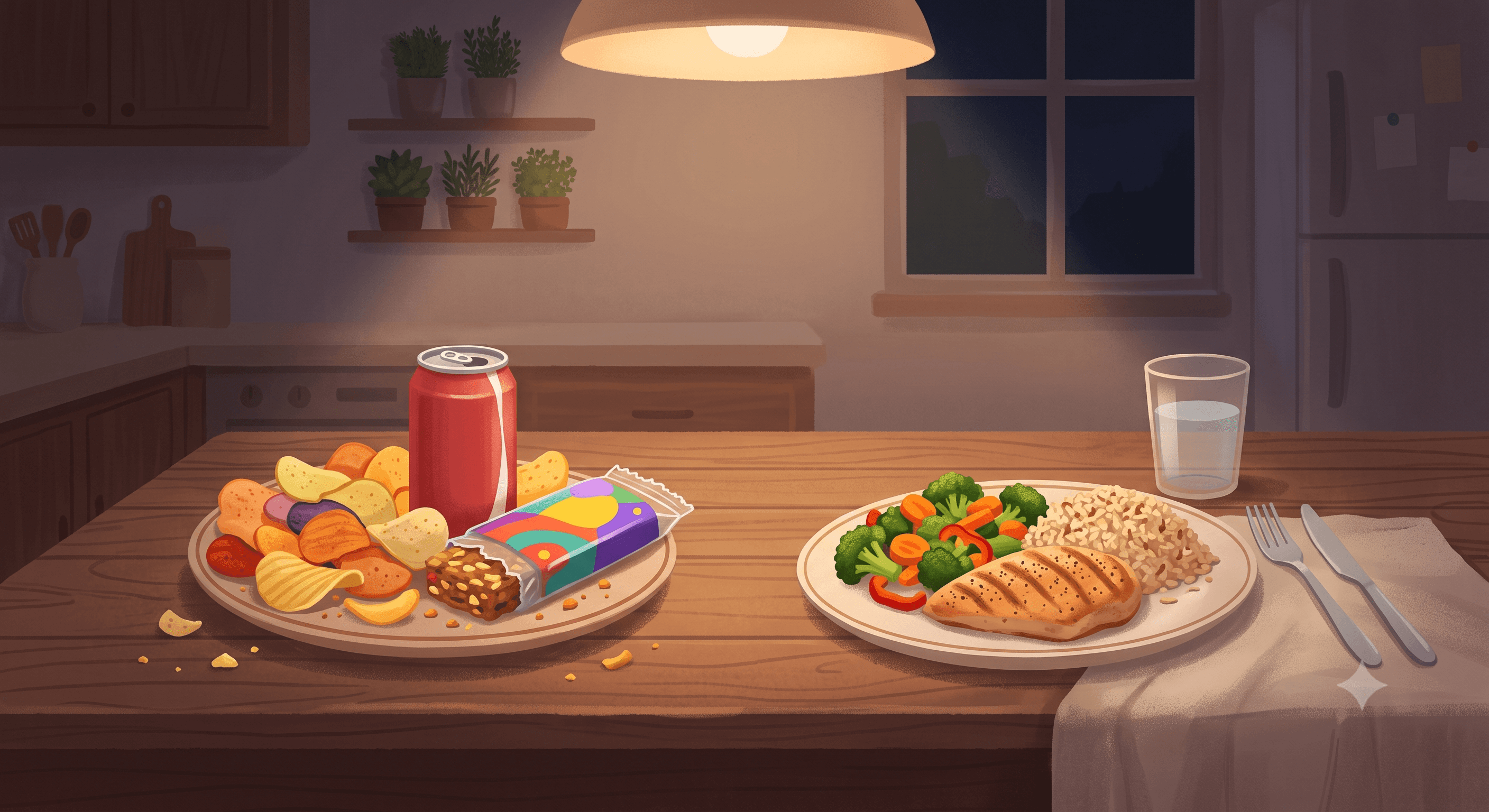
AI-generated illustration
The Food That Quietly Cancels Your Deficit
How ultra-processed foods speed up eating and inflate your calorie intake
Soft texture, high energy density, and bold flavor let you take in a lot of calories fast. Fullness signals often kick in only after a large chunk of the portion is already gone. A person can finish the package before deciding they're full.
Dense food loaded with water and fiber usually takes more chewing, and stomach volume fills up at a lower calorie cost. Eating speed turns out to be a measurable property of food, even though it's not printed anywhere on the front of the package.
The controlled-kitchen experiment
In an inpatient study by Kevin Hall and colleagues, 20 adults took part. Each person was given, in turn, an ultra-processed diet and a minimally processed one. Meals were offered in excess, so participants could eat until full. The diets were matched for stated macronutrients, sugar, sodium, and fiber.
On the ultra-processed diet, people ate roughly 508 more calories per day. Over the short period, body weight rose on that diet and fell on the minimally processed one. The difference showed up without any instruction to overeat and without participants trying to derail the experiment.
What actually drives overeating
Processing level alone doesn't explain every result. Intake is shaped by a combination of energy density, texture, palatability, and eating speed. Researchers are still working out how much each factor contributes on its own.
Liquid calories and soft snacks offer little resistance while eating. Fiber added to a drink behaves differently from fiber inside a whole food. Many ultra-processed products stack several of these traits at once, though an individual packaged item can still have a reasonable nutritional profile.
How to use this without food policing
It's more practical to change the foundation of a meal. A plate built around a protein source, vegetables, and a whole-food side lowers overall energy density, while a sauce or dessert stays a manageable part of the meal. That approach works more concretely than judging every package on moral grounds.
Start by swapping one habitual ultra-processed meal for a homemade version and compare how full you feel. Cookies can still fit into your diet if the portion is decided in advance. A bag sitting open on the table usually makes portion math a lot harder.
Certified nutritionist with 8 years of hands-on consulting experience. Works with real people, their habits, their setbacks, and their everyday kitchen realities.